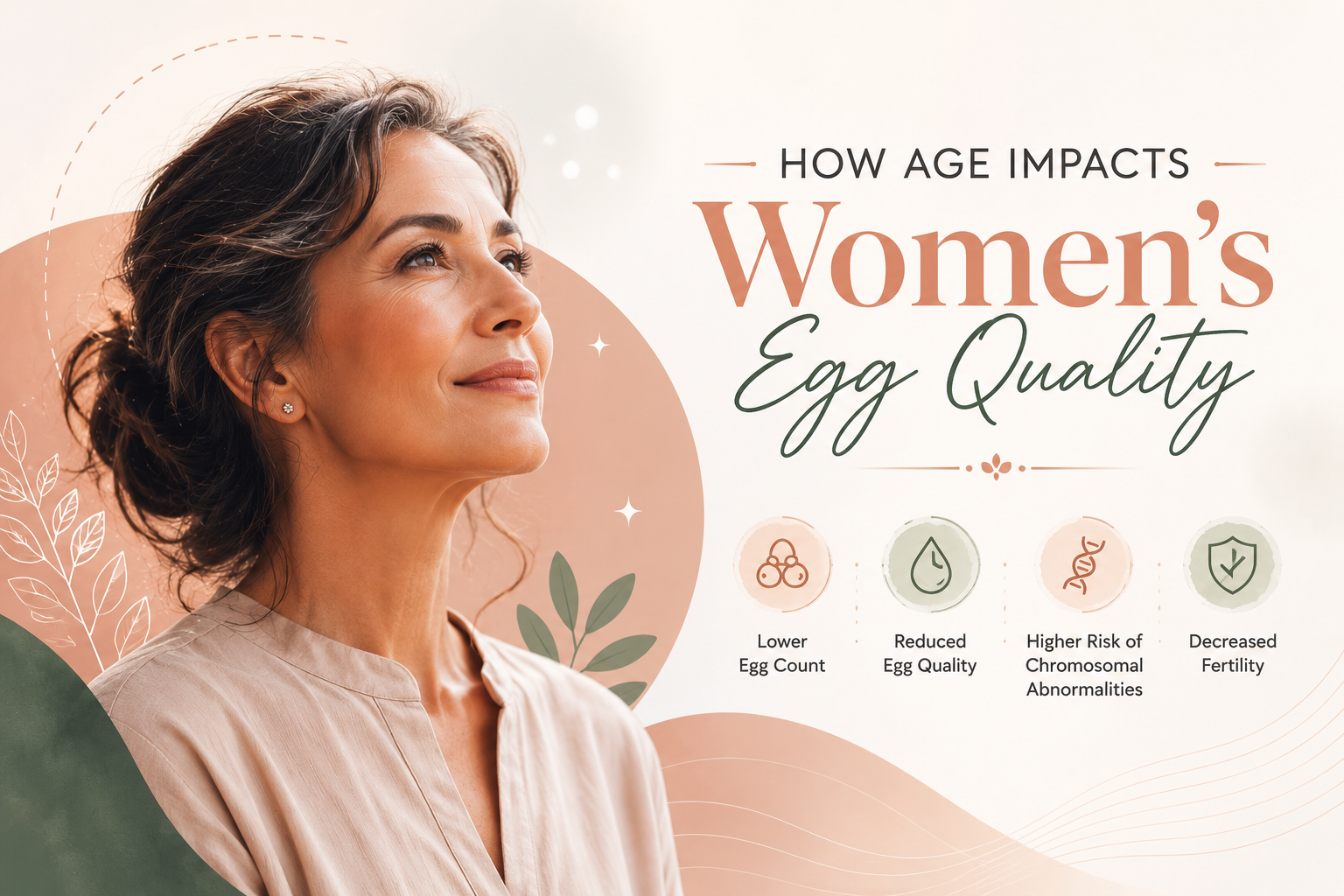
Fertility is one of the most remarkable aspects of a woman's reproductive health. It reflects the incredible potential to create new life, but it is also influenced by a complex interplay of biology, genetics, hormones, and lifestyle. Among all these factors, one stands out as the most consistent and predictable determinant of fertility: age.
Understanding how age affects egg quality is not about creating fear or urgency—it is about empowering women with knowledge. Whether you are planning to conceive soon, considering delaying pregnancy, or simply want to understand your reproductive health better, knowing how your ovaries change over time can help you make informed decisions.
Unlike men, who continue to produce new sperm throughout their lives, women are born with their lifetime supply of eggs. At birth, a baby girl has approximately one to two million immature eggs. By puberty, this number declines to around 300,000–500,000, and with each menstrual cycle, both the quantity and quality of eggs gradually decrease.
While the number of eggs—known as the ovarian reserve—is important, egg quality plays an even greater role in determining fertility. Egg quality refers to the likelihood that an egg contains the correct number of chromosomes and has the ability to be fertilized, implant successfully, and develop into a healthy pregnancy. Throughout her reproductive life, she will ovulate only about 400-500 of these eggs. The rest are lost through a natural process called atresia (follicle degeneration). But it's not just about the quantity; it's about the quality. And this is where age takes center stage.

***i. How egg quality changes with age and affects fertility.***
Egg Quality in Your 20s: The Peak of Fertile Potential
From a biological perspective, your 20s represent the peak of your reproductive years. During this decade, both the quantity and quality of your eggs are at their best, giving you the highest chance of achieving a healthy pregnancy.
Why are your 20s considered your fertility prime?
Excellent egg quality The eggs released during this stage are more likely to be chromosomally normal, increasing the chances of successful fertilization, healthy embryo development, implantation, and a full-term pregnancy. The risks of miscarriage and chromosomal abnormalities are also at their lowest.
Optimal ovarian reserve
Not only is egg quality at its peak, but the ovaries also contain the largest remaining pool of eggs compared with later years. This provides greater reproductive potential and flexibility.
Balanced reproductive hormones Hormones such as estrogen, progesterone, follicle-stimulating hormone (FSH), and luteinizing hormone (LH) usually work in harmony, resulting in regular ovulation and predictable menstrual cycles.
The Modern-Day Fertility Paradox
Ironically, the years when fertility is biologically at its highest often coincide with a period when many women are focused on higher education, career development, financial stability, or finding the right life partner. As a result, many women choose to postpone pregnancy until later in life- a completely valid personal decision, but one that should be made with an understanding of the natural decline in fertility that occurs with age. Being aware of this biological timeline is not about creating pressure; it is about making informed reproductive choices that align with your personal goals and circumstances.
Protecting Your Future Fertility
Your 20s are also the ideal time to safeguard your reproductive health. Simple lifestyle choices today can have a lasting impact on your fertility in the future. You can help preserve your fertility by:
- Avoiding smoking, vaping, and recreational drugs.
- Maintaining a healthy body weight through balanced nutrition and regular physical activity.
- Practicing safe sex to reduce the risk of sexually transmitted infections (STIs), which can damage the fallopian tubes and affect fertility.
- Seeking early evaluation and treatment for conditions such as polycystic ovary syndrome (PCOS), endometriosis, thyroid disorders, or pelvic infections.
- Scheduling routine gynecological check-ups and discussing any menstrual irregularities or fertility concerns with your healthcare provider.
- Remember, while age is the single most important factor affecting fertility, many aspects of reproductive health are within your control. Investing in your health during your 20s lays a strong foundation for your fertility, whether you plan to start a family now or years from today.
Egg Quality in Your 30s: A Decade of Conscious Change
The early 30s are still a highly fertile period, but a subtle shift begins, often accelerating after age 35.
The Quantity and Quality Dip: Around age 32, the decline in both the number and quality of eggs becomes more pronounced. The "best" eggs have been ovulated in prior years, and the remaining pool has a higher percentage of those with chromosomal abnormalities.
The Statistics Shift: While many women conceive naturally and healthily in their 30s, the chances per cycle decrease. There is a gradual increase in the time it takes to conceive, along with a rising risk of miscarriage.
Navigating Your 30s with Awareness
This isn't a cause for alarm, but a call for consciousness. Your 30s are the perfect time to be proactive.
Consider a Fertility Checkup: If you're planning to wait, basic tests like an AMH (Anti-Müllerian Hormone) test and an antral follicle count performed during a transvaginal ultrasound can provide a snapshot of your ovarian reserve.
Explore Egg Freezing: For those who wish to preserve their fertility options, freezing eggs in the early 30s can effectively "pause" the biological clock for those specific eggs.
Prioritize a Fertility-Friendly Lifestyle: Nutrition, stress management, and maintaining a healthy weight are powerful tools to support your hormonal ecosystem.
If you are actively trying to conceive, it's recommended to seek help after one year of trying (or six months if you're over 35).
Egg Quality in Your 40s: Navigating a New Fertility Landscape
By the time a woman reaches 40, the impact of age on fertility is significant. Most women will have less than 3% of their original egg supply remaining.
A Steep Decline in Quality: The rate of chromosomally abnormal eggs increases dramatically. This leads to a natural conception rate of less than 5% per cycle and a significantly higher risk of miscarriage, which can be as high as 40% or more by age 43.
The Role of Assisted Reproduction: This is where modern medicine offers powerful alternatives. While natural conception becomes more challenging, many women in their early 40s achieve their dream of motherhood through IVF, often using donor eggs or previously frozen embryos. These journeys can be more emotionally and physically demanding, but for many, they are profoundly worthwhile.

***ii. Healthy egg vs. reduced quality eggs. Major differences.***
Conclusion: Age, Egg Quality & IVF
Understanding how age affects egg quality helps you make informed decisions about your fertility. While age-related decline in egg quality cannot be reversed, it does not mean pregnancy is impossible. IVF cannot improve egg quality, but it can increase your chances of pregnancy by using advanced fertility techniques, selecting the healthiest embryos, and, when appropriate, recommending donor egg IVF. If you are concerned about poor egg quality, low AMH, or age-related infertility, consult a fertility specialist early. At Hardik IVF & Fertility Center, we offer personalized fertility assessments and advanced IVF treatments to help you plan your journey to parenthood with confidence.